"[M]ore Latinos were lynched in California than were persons of any other race or ethnicity." -Ken Gonzales-Day, Lynching in the West: 1850-1935 (Duke, 2006)
Welcome to the past... As Ken Gonzales-Day's important new book Lynching in the West: 1850-1935 makes clear, in California and many western states the majority of lynching victims were Latino. This is a history still being told in ever varying shades of black, brown, and the white sheets and hoods that must be wrested from derelict political bodies in order to demand a literal and symbolic accounting of the corpus delicti.
August 29, 1970? No, LA on May 1, 2007. I'll risk an incendiary question because the circumstances demand it: Would police brutality of this magnitude be tolerated if the ethnic, racial, or minority group in question were anything other than Latino? Rhetorical questions are sometimes the necessary, if not egregiously overdue, starting points for more pointed engagements with "American" cultural history.
I'd never thought I'd be saying this, but to their credit, FOX actually aired this story.
Mexicans Americans have found it difficult to imagine state power in the US to be anything but arbitrary since the "Mexican Repatriation" of 1930 to 1934. Occasioned by the Great Depression, the forced deportation of over 500,000 Mexican Americans to Mexico made the idea of state protection for nationals of Mexican ancestry in the US a failed legal promise with limited dividends (over 60% were US citizens, many others were legal residents). So as the nation contemplates immigration "reform" what is surprising is that in the convoluted history of Mexican American rights initiatives and immigration battles there have been so few attempts at mass rallies and demonstrations on the national scene. Tonight, on the eve of the May Day rallies across the US, it is also surprising that we are already being given a narrative about how it will likely pale in comparison to last year's national rallies and demonstrations.
LOS ANGELES — Marchers demanding a path to U.S. citizenship for as many as 12 million undocumented immigrants will take to the streets in many cities Tuesday, but organizers say crowds will fall far short of last year's giant rallies on May 1.
A year ago, police estimated that more than 1 million people rallied for rights for illegal immigrants and against a short-lived proposal in Congress that would have made illegal entry to the USA a felony.
Crowds were estimated at 400,000 in Los Angeles, 400,000 in Chicago, 30,000 in Houston and 20,000 in New York City. In economic boycotts billed as "a day without immigrants," hundreds of thousands of Hispanic workers and their supporters didn't punch the clock. The ports of Los Angeles and Long Beach shut down, and 72,000 students walked out of classes in Los Angeles.
In contrast, a march here Tuesday is likely to attract no more than "tens of thousands," says Javier Rodriguez of the March 25 Coalition, a group named for a rally of 500,000 here in 2006.
In Tucson, where 18,000 marched last year, 10,000 are expected to turn out, says Frida Espinosa of the Tucson May 1 Coalition. There's comparatively little talk of boycotts.
Event planners attribute part of the difference to nationally syndicated Spanish-language radio disc jockeys. They whipped up crowds last year but have shifted political tactics.
The popular Eduardo Sotelo, known as Piolín or "Tweetybird," is asking listeners to write a million letters in support of immigration changes. He says he'll deliver those letters to Congress. Renán Almendárez Coello, the DJ known as El Cucuy ("the boogeyman"), says persuading legal residents to become citizens and vote is more effective than marching.
"It was very nice to see everybody walking around and being supportive and not making a big mess, but it is more important to register and vote," he says.
Demonstration organizers also attribute lowered expectations to fragmented leadership, discouragement that Congress approved no immigration bill last year and a more punitive climate.
"The situation has changed drastically for us," says Armando Navarro, coordinator of the National Alliance for Human Rights. "Last year, there was a sense of passion and determination, inspired by fear of criminalization and rising expectations for legalization. The political climate is becoming more restrictionist right now, and our capacity to respond is not there."
As cities such as Hazleton, Pa., pass laws cracking down on illegal immigrants, U.S. Immigration and Customs Enforcement stages raids on workplaces to detain undocumented workers.
By displaying such toughness in protecting borders, President Bush could soften opposition to the kind of immigration bill he wants: one that would combine stepped-up law enforcement with a path to citizenship for illegal immigrants.
House Republicans blocked such a bill last year after the Senate passed it. Democrats now control Congress and side with Bush on the issue, but Republican votes are needed.
Immigrant rights groups are split over the latest proposal in Congress, sponsored by Reps. Luis Gutierrez, D-Ill., and Jeff Flake, R-Ariz. The bill would provide a way to earn citizenship that "could take up to 20 years," the skeptical Navarro says.
Navarro says activists did little to keep immigrant communities mobilized after last year's rallies and find it hard to "rekindle that spirit." Jorge-Mario Cabrera, a spokesman for the Central American Resource Center here, cites one reason it's so hard: "There is a real disappointment in the community that last year we became so engaged, and nothing happened."
The New Mexico National Guard is overwhelmingly comprised of Chicanos. After they arrived in Kuwait recently, a soldier from Wisconsin told superiors that he believed the Chicano servicemen were "gang-members." After an Army specialist was flown in to investigate and examine their bodies, they were stripped and searched for tattoos. Few tattoos were found, and none with gang-related markings.
While Gov. Bill Lopez [sic] Richardson of New Mexico praises the Minute Men gangs along that state's border with Mexico, he seems unable or unwilling to decry the racialized profiling of Mexican American National Guard soldiers in Kuwait under the Army's leadership. (See a video of the alleged "gang-members" prior to deployment above. For original source see here.)
Task force says Army searched soldiers for tattoos because they’re Hispanic
ALBUQUERQUE — At a base in Kuwait last May, nearly 60 members of a New Mexico National Guard unit were told to remove their shoes, socks and shirts so that military investigators could check them for gang tattoos.
Several members of the Rio Rancho-based Task Force Cobra alleged racial discrimination, saying the unit was targeted because of its large number of Hispanics.
Army investigators, however, found that the tattoo search was lawful and not racially motivated, the Albuquerque Journal reported in a copyright story published Sunday. “I’m embarrassed to say that’s how the Army is,” said Adjutant Gen. Kenny Montoya, who commands the Army and Air National Guard in New Mexico. “They don’t want to admit mistakes.”
Within days of the search, Montoya wrote to a senior Army officer in Kuwait, requesting an apology be made to Task Force Cobra. None was given.
Montoya was more pointed in a letter the following month to Gen. Peter Schoomaker, then-chief of staff of the Army. “Let me know how I can help our Army to end their discriminatory practices, both now and in the future,” Montoya wrote.
Schoomaker didn’t respond.
The tattoo search was based on an uncorroborated allegation made by a Wisconsin soldier that Task Force Cobra was rife with gang members.
Members of the military are prohibited from taking part in gang-related activity if the gang is an extremist organization — for example, it advocates discrimination, hate crimes or violent acts. A soldier can face disciplinary action, including discharge for having a tattoo of an extremist group.
On May 25, 2006, agent Paul McGuire with the Army’s Criminal Investigation Command arrived at the Ali Al Salem base in Kuwait to conduct the tattoo check and immediately was confronted about his expertise in identifying gang tattoos.
A lieutenant with Task Force Cobra told the agent that all of his platoon sergeants had backgrounds in law enforcement and would know if gang activities were occurring.
Nevertheless, the soldiers were ordered to strip down to their athletic shorts.
Six of the 58 soldiers initially refused to be searched but complied after being threatened with arrest and charges by the investigating agent.
One New Mexico soldier complained “that he didn’t feel like an American today,” according to Army documents. Another reportedly cried, saying it reminded him of a similar incident that occurred when he was younger because he was Hispanic. Another soldier said the “Gestapo-like” tattoo check was the lowest point of his military career.
“During the viewing, there was high tension among the troops who related they felt as though they were being picked on ... because they were Hispanic and National Guard,” McGuire later said.
Task Force Cobra is made up of nearly 190 soldiers from various National Guard units around New Mexico. It was deployed in November 2005 to provide security for military convoys in Iraq, Kuwait and Qatar, and returned last November.
Additional members of the group were scheduled to be searched, but unit leaders and senior Army officers blocked that plan.
Capt. Ivan Forrest Salkin, the commander of the unit who had been visiting another base, ordered that there would be no more checks until the investigating agent produced a search warrant, Army documents state.
He said he had no idea that the tattoo check was an issue with his soldiers. He also objected to his soldiers being threatened with arrest for refusing to comply.
As word of the tattoo search worked its way up the chain of command, a top Army lawyer also expressed concern.
“It is too easy for this to be viewed as a witch hunt, where all of the unit members are presumed guilty until proven innocent,” Col. Ralph M.C. Sabatino, a judge advocate, wrote in an e-mail to McGuire a day after the search.
“The fact that all of this is being done on the uncorroborated vague and nonspecific accusations of a soldier ... only exacerbates the problem,” Sabatino said.
Guns and “gun rights laws” have a coterminous and nearly forgotten history in the Americas. When white or Criollo elites were the “minority,” guns were used to control enslaved bodies which were (depending where you were in the Americas) black, mulatto, Amerindian, or some combination of these or other taxonomies used to describe the enslaved majority.
Policing the enslaved body and quelling slave insurrections were part of the fiber and logic of a racism that created both the taxonomies of race and the pseudo-science that legitimated its various guises in order to sustain the emergent national economies. Whether they were called “pattyrollers” or “verdugos,” slave catchers and armed white militias protected the slave-owners’ lands from insurgent bodies on the plantation and beyond as property to be returned if any slave managed to escape.
So it is without irony, or the hint of satire, that we see the latest “insurgents” in the leaked National Rifle Association’s graphic novella (alert thanks to Salon.com and the always amazing Tex[t] Mex blog). The subaltern bodies are constructed anew as threats to the now white majority, necessary targets of the fearless head-of-household dads who must protect this perverted justice a la Michael Douglass in Falling Down.
(left: Red from "Red Dead Revolver" video game, Rockstar Productions, 2006)
Reperire pax, “find peace,” is certainly a noble enough call to justice and the raison d’être of Red, the protagonist of the videogame Red Dead Revolver. But Red—pictured with this imperative call literally crowning one of his revolvers—attempts to find it through the pursuit and annihilation of Mexican General Diego and those of similar ilk who killed his family when he was a boy. Armed with his father’s revolver as a literal and metonymic emblem of forced penetrations, Red’s quest partakes of a cultural repertoire of images that have infused the American popular imagination with murderous Mexicans from the nineteenth century to the present.
But playing American in this context is about being played. From the serial western novel, to the Lone Ranger radio show of the 1940s and, later, the television show of the 1950s, and its heirs in the Hollywood and spaghetti westerns, all the way to Walker, Texas Ranger, "Red Dead Revolver" continues an investment in American national identity through a folk mythology that is neither historically factual nor ethically accountable. As an exemplar of the processes by which American cultural memory and amnesia find public expression, Red evinces the continued investment in an American national fantasy that requires continuous interrogation, resistance, and illumination. Reperire pax, indeed.
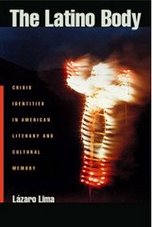
The Latino Body: Crisis Identities in American Literary and Cultural Memory (NYU Press, 2007) tells the story of the United States Latino body politic and its relation to the state: how the state configures Latino subjects and how Latino subjects have in turn altered the state. This interactive blog continues some of the discussions initiated in the book and, in the process, expands the book’s obsessions by further interrogating national conceptions of Latina and Latino forms of personhood and how these have been written on the Latino body. (The book was published by NYU Press' Sexual Cultures Series.) Irreverent, polemical, visually provocative, and hopefully fun to peruse, the interactive blog is meant to persuade and influence conversations on and about the Latino body politic. Send related images, videos, art and text to me at lazlima@gmail.com. You can get the book directly from NYU Press and Amazon.
Book Blurbs
"Through a bricolage of carefully crafted textual readings, Lima has produced a text that traces the relationship between corporeality and citizenship by marking the process by which the Latino body has become historical. Situated in moments of national and bodily crisis, his archive is decidedly precise and imaginatively expansive, metaphorically rich and politically dynamic. Drawing on texts central to third world feminism, queer studies, and Latin and Latino American literatures, this work is as central to rethinking the American literary canon as it is to an invigorating remapping of Latino Studies." —Juana María Rodríguez, University of California, Berkeley, author of Queer Latinidad
"Lima's Latino Body promises to productively disrupt the business-as-usual of critical and scholarly practice in the still-emerging field of U.S. Latino studies; it will contribute directly to the next stage in the long process of what it itself terms Latino identity's 'becoming historical' in North American cultural, political, and intellectual contexts. For this reason alone, The Latino Body could not be more welcome, or more timely."
—Ricardo L. Ortíz, Georgetown University, author of Cultural Erotics in Cuban America